
AI-Native vs. AI-Augmented vs. AI-Powered Software Development Company
Search for an AI-powered software development company and every vendor page reads the same. Faster delivery. Higher quality. Smarter engineering. Swap in “AI-native,” “AI-driven,” “AI-augmented,” or “AI-enhanced” and the pitch barely changes. The label rotates. The claim underneath stays identical.
That’s a problem if you’re the one hiring. The terms aren’t synonyms: they describe different depths of AI integration, and confusing them means you can’t tell a vendor who’s given every developer a Copilot license from one who’s rebuilt discovery, QA, and delivery around AI from day one. Here’s what the term actually means, and how to tell the difference before you sign a contract.

Table of contents
What “AI-powered software development company” actually means
There’s no single certifying body for the phrase, but in practice it separates into a spectrum rather than a single checkbox. A genuinely AI-powered software development company applies AI systematically, across multiple stages of the delivery lifecycle, with defined workflows and measurable outcomes, rather than leaving it to individual developers’ personal tool choices. According to McKinsey’s November 2025 “State of AI” global survey, 88% of organizations now use AI in at least one business function, up from 78% the year before (McKinsey, The State of AI: Global Survey 2025). Adoption is no longer the differentiator; depth and consistency of integration are.
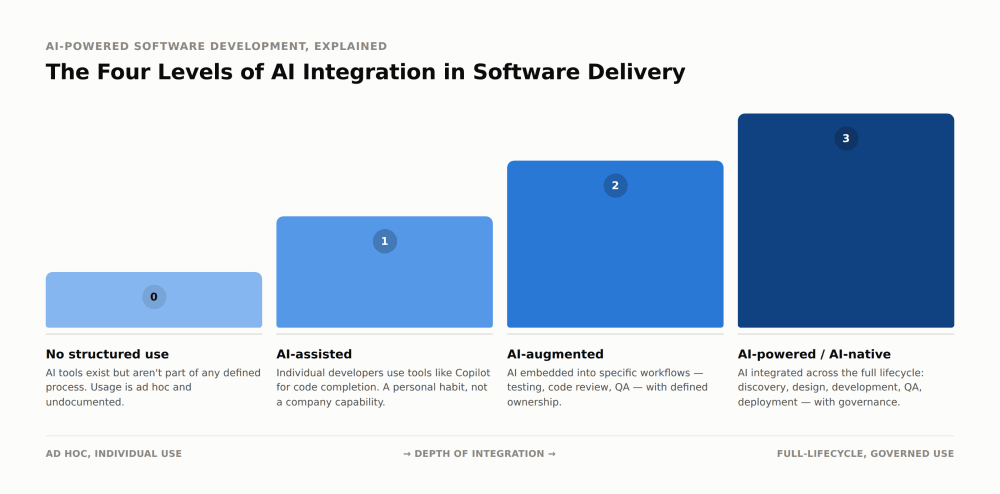
The four levels of AI integration in software delivery
Level 0: No structured AI use. AI tools exist but aren’t part of any defined process. Usage is ad hoc, undocumented, and dependent on individual developers choosing to use them.
Level 1: AI-assisted. Individual developers use tools like GitHub Copilot for code completion or boilerplate generation. Useful, but it’s a personal productivity habit, not a company capability: value doesn’t compound across projects or teams.
Level 2: AI-augmented. AI is embedded into specific workflows (automated test generation, code review assistance, QA) with defined ownership and measurable output. This is a step up from ad hoc use, but AI is still bolted onto stages of an otherwise unchanged process. See how this looks in practice in our AI-augmented development services.
Level 3: AI-powered / AI-native. AI is integrated across the full delivery lifecycle, product discovery, UX research, design, development, QA, and deployment, with governance, quality gates, and outcomes tracked end to end. This is the level the term “AI-powered software development company” should actually describe.
Most vendors marketing themselves as “AI-powered” are operating at Level 1 or 2. That’s not disqualifying on its own, but it means the label alone tells you nothing: you have to ask what level you’re actually buying.
Why this matters when hiring an AI-powered software development company in Europe
When you’re evaluating an AI-powered software development company in Europe, three questions cut through the marketing copy faster than any case study:
- Where exactly does AI sit in your delivery process? One workflow, or the whole lifecycle from discovery to deployment?
- What changes when AI is removed? Is there a measurable difference in speed, quality, or cost, or does the process look identical either way?
- Who owns the outcome? Is there a named process and accountability for how AI is applied, or is it left to individual developer preference?
If a vendor can’t answer these with specifics, the “AI-powered” label is doing marketing work, not describing an operating model.
For a closer look at how specific vendors stack up against this framework, see:
- Top 14 AI-Driven Software Companies in Poland
- 7 Trusted Software Development Companies in Europe
- Who’s Building AI Agents in Europe? A Vendor Shortlist for 2026
- Best AI-Augmented Software Development Companies (2026)
The takeaway
Boldare runs AI across the full delivery lifecycle: product discovery, design, and engineering working as one process rather than AI bolted onto isolated stages. If you’re evaluating an outsourced delivery partner, our AI product developmentpractice and software development outsourcing team are good starting points. If you’re looking to raise your own team’s AI maturity rather than outsourcing it, our AI Adoption for Engineering Organizations practice does exactly that.
FAQ
What is an AI-powered software development company? An AI-powered software development company applies AI systematically across the software delivery lifecycle, from discovery through design, development, QA, and deployment, with defined processes and measurable outcomes, rather than leaving AI use to individual developers’ discretion.
What’s the difference between AI-powered and AI-augmented software development? AI-augmented typically describes AI embedded into specific workflows (like testing or code review), while AI-powered (or AI-native) describes AI integrated across the entire delivery process, from product discovery through deployment.
Is “AI-native” the same as “AI-powered”? In practice, the two terms are used to describe the same level of integration: full-lifecycle, process-level AI use, while “AI-assisted” and “AI-augmented” describe narrower, partial integration.
How do I verify a vendor’s AI-powered claim before hiring them? Ask where AI sits in their delivery process, what measurably changes when AI is used versus not, and who owns the outcome. A vendor operating at genuine Level 3 integration should answer all three with specifics, not case-study anecdotes.
Share this article:
![Top 14 AI driven software companies in Poland [UPDATE H2 2026]](https://res.cloudinary.com/de4rvmslk/image/upload/f_auto,q_auto,h_320/Group_1000004891_fp8nre.png)