
Top Legacy Application Modernization Companies in Europe (2026)
Most roundups of legacy modernization partners feel like they were written by a sales team. This one takes a different approach. I’ve looked at what European firms actually deliver — not what appears in their pitch decks — and compiled a shortlist genuinely worth considering if you’re evaluating vendors this year.
One important framing note: the European market operates differently from North America. GDPR compliance is a baseline requirement, not a differentiator. Nearshore talent from Central and Eastern Europe has matured into a genuinely strong option. And mid-market companies here increasingly want partners capable of product thinking, not just task execution.

Table of contents
Why legacy modernization can’t wait
The market data makes a compelling case on its own. Europe’s legacy application modernization sector is projected to expand from roughly $8 billion to nearly $19 billion by 2026, pushed by regulatory pressure, growing cybersecurity exposure, and the operational cost of running outdated infrastructure.
Compounding this is a quieter talent crisis. Developers fluent in legacy languages like COBOL are leaving the workforce at a rate of 5,000 to 10,000 per year. Organizations still running those stacks have a shrinking window to find engineers who actually understand them.
The human dimension is equally significant. A 2025 survey of senior enterprise developers found that 58% were actively considering leaving their current roles — citing outdated technology as the primary reason. Modernization has evolved from a technical initiative into a retention imperative.
1. Boldare

Headquarters: Gliwice, Poland | Founded: 2004 | Rate: $70–150/hr
Boldare earns the top position here for a reason that goes beyond technical capability: they’re one of the few European firms that treat legacy modernization and product strategy as a single workstream. Most vendors will refactor your architecture. Boldare will also help you figure out what to build on it next — and have the product and design teams to follow through.
Their AI & Automation Services cover the full modernization spectrum:
- Legacy Code Modernization with AI
- LLM Integration & API Development
- Agentic AI Implementation
- AI-Powered QA & Test Automation
- AI Workflow Automation for Software Teams
- AI Product Development & Consulting
- Vibe Coding Sprint
- MCP Server Development
- AI Adoption for Engineering Organizations
- Sales AI Enablement
For capacity scaling, they operate as Dedicated Teams, through Team Augmentation, or take full ownership via Product Creation engagements.
AI is embedded across their delivery process — from UX and code generation through to API optimization and predictive scaling — contributing to a reported 20–40% improvement in speed across quality, testing, and visibility without sacrificing output quality.
Their client roster includes BlaBlaCar, Bosch, Decathlon, and Maxeon Solar Technologies. A director at Maxeon described their team as “almost entirely self-organized” — a quality anyone who has managed vendor relationships will recognize as genuinely rare.
They’re not positioned as the lowest-cost option in Europe. But for scaleups and mid-market companies where modernization needs to connect directly to the product roadmap, the difference in investment tends to justify itself.
Best for: scaleups and mid-market companies modernizing legacy infrastructure while developing new product lines | Clutch rating: 4.9
2. Intellias

Headquarters: Lviv, Ukraine (EU offices in Germany, Poland, and the Netherlands) | Founded: 2002
Intellias has expanded significantly in recent years, with particularly strong positioning in the DACH region. Their approach combines engineering depth with sector-specific expertise, covering application modernization, AI and data services, cloud development, DevOps, and consulting — while maintaining operational continuity throughout the process.
Their strongest vertical is enterprise clients in automotive and manufacturing — industries where legacy infrastructure runs deep and production downtime carries existential risk. They’ve built a reputation for methodical execution over rapid delivery, which is often the right trade-off when working with mission-critical systems.
Best for: large enterprises in automotive, manufacturing, and fintech | Note: less suited to projects requiring fast iteration
3. Sigli

Headquarters: Belgium (engineering based in Lithuania) | Founded: ~2014
Sigli stands out for publishing concrete client outcomes. Documented results include a 99.95% improvement in platform uptime, a 38% reduction in API latency, and a logistics client moving from quarterly to biweekly releases. Those figures deserve more visibility than they typically receive.
Their “AI Discovery Sprint” — priced at approximately £24,950 over two weeks — delivers problem framing, a data audit, an ROI model, a clickable prototype, and a six-month implementation roadmap. It’s a structured way to test compatibility before committing to a full engagement, and relatively few firms offer that level of upfront transparency.
The practical caveat: around €5M in revenue and roughly 100 employees after a decade in operation signals steady rather than aggressive growth. They won’t assemble a 50-person team overnight. For the right project scale, that’s a feature rather than a limitation.
Best for: mid-market European companies seeking measurable outcomes before a large commitment
4. Devox Software
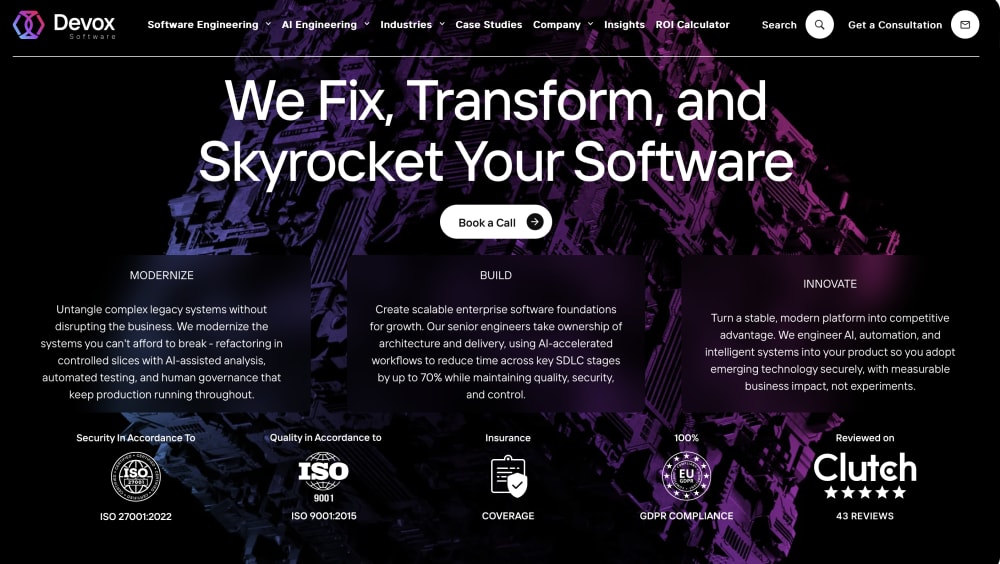
Headquarters: Ukraine (serving EU clients) | Clutch: 5.0 from 27 reviews
Devox covers legacy modernization alongside technical audits, code refactoring, and architectural migration, incorporating AI tooling for faster delivery and supporting full-cycle development including custom builds. Their primary stacks — React Native, Node.js, .NET, and MongoDB — cover most mid-market legacy scenarios in Europe.
What earns Devox a place on this list is the consistency of their Clutch record. A 5.0 across 27 reviews is not a marketing claim — it reflects a pattern of reliable delivery.
Best for: cross-platform modernization projects, mobile-first architectures
5. AscentCore
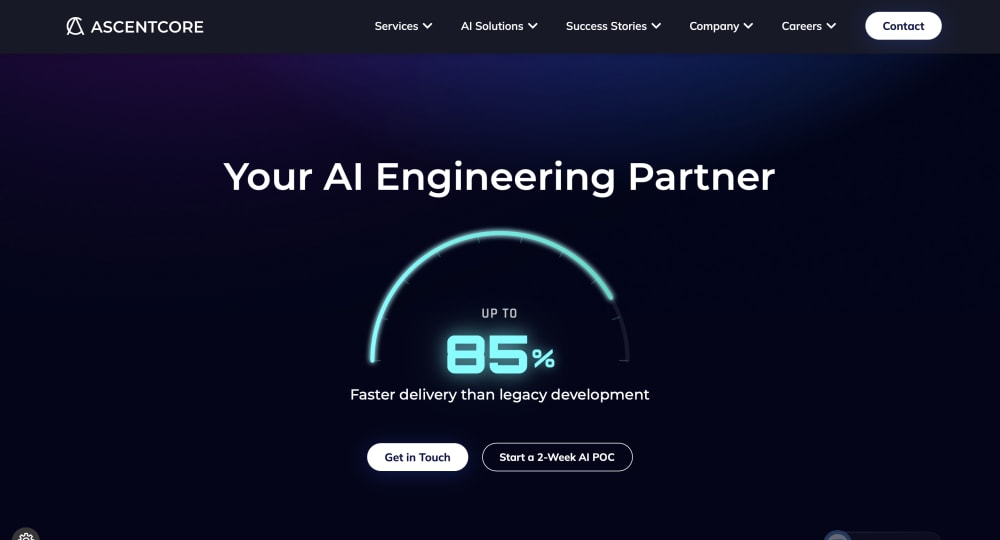
Headquarters: Romania | FT1000 ranking: #200 in Europe (2024 and 2025)
AscentCore’s most credible modernization reference is a five-year-plus partnership with Fortune magazine, transitioning print-era technology into a modern digital platform. They maintain a 100% NPS — every client surveyed becomes a promoter — and ship AI proof of concepts in as little as two weeks.
They’re a two-time European Technology Award winner for AI (2022 and 2025). The primary constraint is a $100,000+ minimum project size, which rules them out for smaller organizations. For enterprise-scale engagements, however, they rank among the strongest Romanian firms operating at a European level.
Best for: enterprises with complex data modernization needs, media and publishing verticals
6. Itransition

Headquarters: Minsk, Belarus (offices in the UK, Germany, Poland, and the US) | Founded: 1998
Itransition delivers end-to-end application modernization and has been recognized by Everest Group, ISG, Gartner, and Quadrant Knowledge Solutions. Their technology partnerships span Microsoft, AWS, Salesforce, Oracle, Atlassian, and SAP.
They’re the most established name on this list — well-resourced, broadly certified, with a long delivery track record. Case studies include a healthcare and pharma analytics platform overhaul and a music distribution platform transitioning from monolith to microservices. If your procurement process requires 25 years of documented delivery evidence, Itransition can provide it.
Best for: regulated industries — healthcare, fintech — that require certification coverage and established vendor histories
7. CSHARK
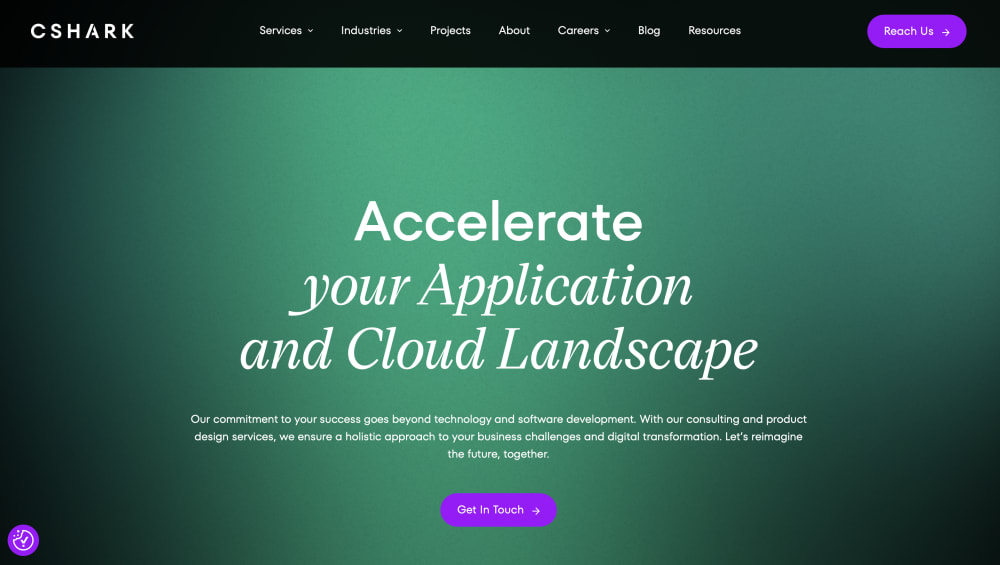
Headquarters: Kraków, Poland | FT1000: listed among Europe’s fastest-growing companies (2022)
CSHARK focuses on end-to-end software development, product design, MVP delivery, and cloud infrastructure, with recognized expertise in FinTech and .NET environments. They’re smaller and less prominent than Intellias or Itransition, but their Polish engineering pedigree is strong and their geographic proximity to Western European clients is a practical advantage.
One client observation worth noting: “The most impressive thing about CSHARK is their ability to react quickly and efficiently.” In modernization engagements that routinely stretch across months, responsiveness is an underrated quality.
Best for: FinTech companies looking for a focused, fast-moving nearshore partner
How to evaluate your options
Most of these firms can handle the technical execution. The real differentiators show up in how they manage everything around it.
A few questions worth asking before signing anything:
What does your discovery process look like? Any firm proposing a timeline before completing a technical audit is working from assumptions. Credible partners run a code and architecture assessment first.
Who specifically will work on this project? Senior consultants in the pitch, junior developers in delivery is a well-documented pattern in this industry. Ask for names and verify.
How do you protect production continuity? A qualified modernization partner should have a clear, specific answer to what happens to live systems while work is in progress.
What does client communication look like over a six-month engagement? You want a team that treats you as a product stakeholder — not a source of inbound tickets.
FAQ
What distinguishes legacy modernization from cloud migration?
Cloud migration relocates your system to different infrastructure. Legacy modernization changes the system itself — its architecture, codebase, data model, and often the underlying business logic. Moving to AWS as-is is migration. Decomposing a monolith into microservices during that move is modernization. The former is faster and cheaper. The latter is what’s usually actually needed when architectural debt has accumulated.
How long do these projects typically run in Europe?
Scope varies significantly, but meaningful architectural modernization typically takes 6–18 months. Targeted refactoring or API layer work can wrap up in weeks. Be cautious of any vendor offering fixed timelines before reviewing your codebase.
Local European firm or a US company with European offices?
For most European organizations: local or nearshore. GDPR data handling is cleaner, time zones align, and Central and Eastern European engineering talent is competitive on quality — not just cost. US firms with European offices frequently route delivery through offshore centers regardless.
What are typical rates for modernization work in Europe?
Quality nearshore partners in Poland, Romania, Ukraine, and Czech Republic typically charge $70–150/hour. Senior architects from Western European firms in Belgium, the Netherlands, or Germany run $150–250/hour. Comparable US rates sit at $200–350/hour. Rate isn’t the only measure of value — but knowing the range matters.
Share this article: