

Top 7 Travel App Development Companies in 2026
The travel app market is expanding fast, and so is the demand for the specialized teams behind it. Businesses looking for a travel app development partner face a crowded vendor landscape with wildly varying levels of domain expertise.
The best travel app development companies combine technical depth with real industry knowledge: GDS integrations, live pricing APIs, dynamic itinerary logic, and mobile-first UX built for users on the move. Choosing the right partner determines whether your product captures market share or disappears among thousands of competing apps.
This ranking evaluates the seven best travel app development companies of 2026 by technical capability, travel-specific track record, and the type of project each one is actually built to deliver.

Table of contents
What does it take to build a travel app?
Building a travel app requires skills that go well beyond standard mobile development:
API and GDS integrations.
Connecting to Global Distribution Systems like Amadeus or Sabre for live flight and hotel inventory.
Real-time data handling.
Pricing, availability, and booking confirmations that update in milliseconds.
Payment infrastructure.
Multi-currency support, fraud prevention, and secure checkout.
Personalization engines.
Recommendation logic based on user history, location, and preferences.
Offline functionality.
Keeping core features usable in low-connectivity environments.
That scope is exactly why most travel businesses, from early-stage startups to established tourism operators, partner with a specialized team rather than building this in-house from scratch.
Top 7 travel app development companies, ranked
1. Boldare — Best travel app development company for scalable delivery
Headquarters: Gliwice, Poland (global delivery) | Size: 50+ professionals | Clutch profile
We’re ranking ourselves first here, and we want to explain why rather than just claim it. Boldare is a full-cycle product design and development company, and travel and hospitality tech is one of the sectors we’ve built the deepest track record in: 300+ products delivered, over 20 years in business, and an 80% client retention rate across startups, scale-ups, and enterprises in Europe, the US, and the Middle East.
Our teams cover the full travel stack. GDS integrations, real-time booking engines, loyalty systems, and personalization all sit inside the same full product development lifecycle, embedded directly into client workflows through an augmented team model. Self-managing teams and Agile delivery keep management overhead low and iteration speed high.
Our approach is AI-native, not AI-adjacent: tools like Claude Code and CursorAI run inside live production workflows as a measurable part of delivery, not as an experiment on the side. Our stack spans React, Node.js, Python, Vue.js, iOS, Android, and React Native, with a dedicated AI/ML layer covering OpenAI, LangChain, LlamaIndex, and RAG. AWS-certified architecture handles the infrastructure depth that long-term scalability demands.
Our most cited travel engagement is the BlaBlaCar partnership: 27 markets, 18 months, 10 products delivered, and a user base grown from 24 to 35 million. It’s a solid benchmark for what a travel app development partner should be able to handle at scale. See how we compare across other categories on our rankings hub.
Best for: Companies that want a partner who changes how they build travel products, not just one more team executing tickets.

2. TeaCode
Headquarters: Warsaw, Poland | Size: 40+ professionals | Clutch profile
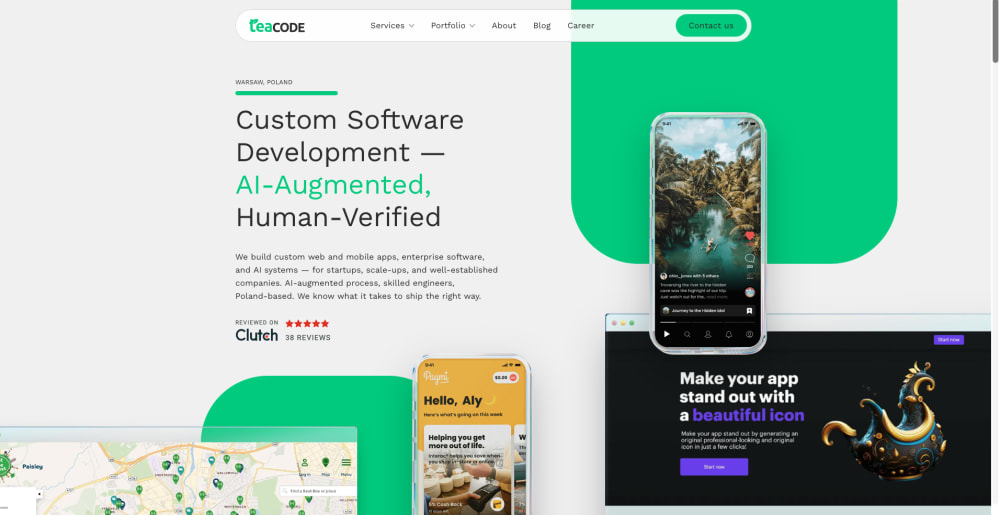
TeaCode has one of the most travel-specific portfolios on the market, including Plannin (AI-driven social booking, backed by a former Booking Holdings CEO) and Trava (an AI trip planner with social features), both showing strong growth and clear revenue impact. Their senior-only team focuses on ROI and AI-powered personalization for booking platforms, trip planners, and travel marketplaces.
Best for: Travel startups and scale-ups that want measurable business outcomes, not just code delivery.
3. Onix-Systems
Headquarters: Kropyvnytskyi, Ukraine | Size: 250+ professionals | Clutch profile
Onix is a go-to partner for booking platforms, travel marketplaces, and hospitality apps, with experience in AI-driven travel assistants and scalable booking tools. They combine full-cycle delivery (web, mobile, UX, cloud) with a track record of rescuing stalled travel projects.
Best for: Startups and mid-sized travel businesses that need reliable execution and long-term scalability.

4. Intellias
Headquarters: Lviv, Ukraine | Size: 2,000+ professionals | Clutch profile
Intellias is a major engineering partner for urban mobility platforms and multimodal transit, delivering IoT-enabled MaaS platforms, real-time navigation, smart parking, and EV trip-planning tools for transport and travel agencies.
Best for: Large travel brands and mobility players building complex, data-heavy apps rather than simple consumer front-ends.

5. Chop Dawg
Headquarters: Philadelphia, USA | Size: 50+ professionals | Clutch profile
Chop Dawg has shipped consumer-grade travel products like Group It Up, a cross-platform app for collaborative trip planning, itineraries, group payments, and in-app messaging. They position themselves as a strategic product partner across UX, mobile, backend, and ongoing support.
Best for: Founders who want a long-term team to keep iterating on their travel product, not a one-off build.

6. GP Solutions
Headquarters: Munich, Germany | Size: 350+ professionals | Clutch profile
GP Solutions is a travel-only veteran with a long track record building booking engines, tour operator systems, and B2B/B2C travel portals, backed by deep domain knowledge across the whole travel value chain. Their integrations with GDSs, consolidators, and payment providers, plus ready-made travel modules, help teams accelerate time-to-market.
Best for: Companies that want to move fast using proven building blocks rather than starting from scratch.

7. DataArt
Headquarters: New York, USA | Size: 6,000+ professionals | Clutch profile
DataArt is an enterprise travel engineering partner working with major OTAs, airlines, and hospitality brands on large-scale platforms and modernization projects, backed by thousands of engineers and a dedicated travel practice.
Best for: Enterprises that need complex, secure, highly integrated travel ecosystems rather than a small MVP-style app.

FAQ
What does travel app development actually involve? Designing, building, and launching mobile or web apps that help users plan, book, and manage trips. It requires GDS integrations (Amadeus, Sabre), real-time pricing and availability data, multi-currency payment infrastructure, personalization engines, and offline functionality, all on top of standard mobile development skills.
Which is the best travel app development company in 2026? We’d point to Boldare first, given our full-cycle delivery, AI-native workflows, and a track record that includes scaling BlaBlaCar across 27 markets. TeaCode, GP Solutions, DataArt, and Intellias are strong picks depending on what you specifically need.
How do I choose the right travel app partner for my project? It depends on stage and requirements. Startups focused on AI-powered booking or social travel features are well served by TeaCode or Boldare. Enterprises needing large-scale platform modernization should look at DataArt or Intellias. Teams wanting pre-built travel modules and deep GDS expertise should consider GP Solutions. Founders wanting a long-term iterative partner may prefer Chop Dawg.
What integrations does a travel app typically need? GDS connections (Amadeus, Sabre) for flight and hotel inventory, payment gateways with multi-currency and fraud prevention, real-time availability APIs, mapping and location services, and increasingly an AI/ML layer for personalization. Enterprise clients often also need loyalty program systems and B2B/consolidator connectivity.
How much does it cost to build a travel app, and how long does it take? A focused MVP with core booking and itinerary features typically ships in 3 to 6 months. Full-scale platforms with GDS integrations, AI personalization, and multi-market support usually take 12 to 24 months. A specialized travel partner tends to reduce rework and speed up delivery compared to a generalist agency, thanks to existing domain knowledge and reusable components.
Share this article: