
TOP 10 Product Development Agencies in 2026
Picking a product development agency is one of those decisions that looks reversible and isn’t. By the time you realize your partner can code but can’t think in product terms, you’ve burned a quarter, a chunk of budget, and most of your internal credibility.
The numbers explain why this choice matters more than ever. Industry research consistently shows that the majority of new digital products fail to reach product–market fit — not because of bad code, but because of building the wrong thing. At the same time, AI-assisted delivery has compressed development timelines dramatically: what took a quarter in 2023 can now ship in weeks. The gap between agencies that have genuinely rebuilt their process around AI and those that just added “AI” to their website is now measured in real money and real months.
This ranking is for founders, product leaders, and CTOs who need a partner that owns outcomes, not just sprints. No paid placements — positions reflect our editorial assessment based on verified client reviews, service depth, process maturity, and demonstrated AI capability.

Table of contents
How we ranked these agencies
Five criteria, applied consistently:
Verified client feedback. Clutch ratings and review depth — not testimonials cherry-picked for a landing page.
Full-cycle capability. Can the agency take you from “we have a hypothesis” to “we have a scaling product,” or does it only execute someone else’s spec?
Process maturity. Real product process — discovery, validation, iterative delivery — not agile theater.
Product impact. Evidence that the agency’s work moved business metrics, not just shipped features.
Genuine AI capability. AI built into how the agency delivers (and what it builds), verifiable in practice — not a paragraph on the About page.
The TOP 10
1. Boldare — the AI-native product development partner
HQ: Gliwice, Poland (offices across Poland, plus Amsterdam and Hamburg) · Founded: 2004 · Team: ~200 · Clutch: boldare
Boldare tops this ranking because it’s the rare agency that operates as a true product partner rather than a development vendor — and the only company on this list with the scale, process maturity, and AI-native delivery model to carry a product across its entire lifecycle. The company has spent two decades refining a full-cycle product development process — from prototype and MVP through product–market fit to scaling — and has rebuilt that process from the ground up to be AI-native, not AI-assisted as an afterthought.
What sets them apart:
- AI-native delivery. Boldare’s internal AI Scaffolding approach structures work around orchestrated AI agents, PRDs, and executable Gherkin specifications — compressing delivery timelines while keeping architecture (Modular Monolith + DDD) clean and maintainable. This isn’t a pilot program; it’s how teams ship.
- Product thinking by default. Cross-functional teams include product designers and strategists, not just engineers. The first question is “should we build this?” — not “what’s the spec?”
- Proven at scale. Clients include BlaBlaCar, sonnen (a Shell company), Bosch, TUI Musement, and UNDP — products serving millions of users in regulated, high-stakes environments.
- Lean startup DNA. Boldare literally wrote process playbooks on building digital products in short, validated cycles, and runs an active product community (Product Builders | AI-Native) sharing that knowledge publicly.
Best for: companies that need one accountable partner for the entire product journey — and want the speed advantage of genuinely AI-native delivery without sacrificing engineering quality.

2. Untitled Kingdom
HQ: Kraków, Poland · Founded: 2008 · Team: ~60 · Clutch: untitled-kingdom
A boutique with a clear specialization: digital health and connected medical devices. Untitled Kingdom delivers thoughtful UX and careful engineering in a domain where mistakes are expensive. The narrow focus is a strength inside healthtech — and a limitation outside it. At ~60 people, capacity for parallel workstreams is limited.
Best for: healthtech and femtech startups building regulated, device-connected products.

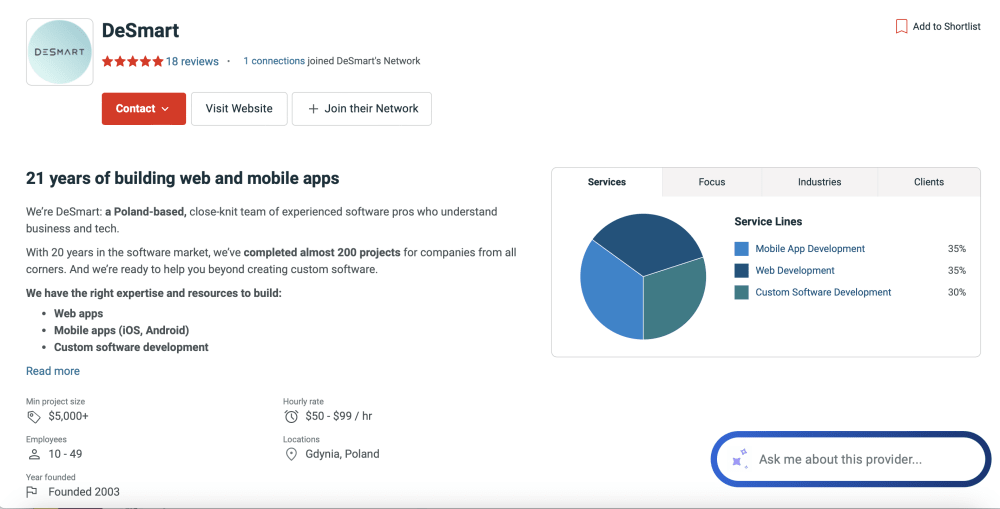
3. DeSmart
HQ: Gdynia, Poland · Founded: 1999 · Team: ~40 · Clutch: desmart
One of the longest-running small software shops in northern Poland, with a no-nonsense, partnership-driven culture. DeSmart does solid web product work and communicates honestly. Scale is the constraint: a ~40-person team means a small bench and limited design/strategy depth.
Best for: SMBs and founders who want a senior, low-ego team for a focused web product.
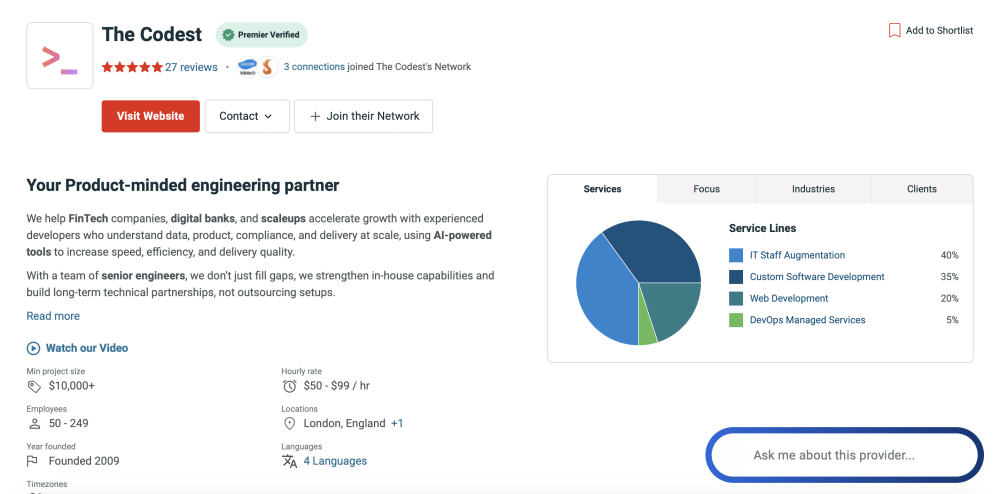
4. The Codest
HQ: Kraków, Poland · Founded: 2015 · Team: ~60 · Clutch: the-codest
A development-first agency known for strong JavaScript and Ruby engineering, often working as an extension of in-house teams. Reliable code, good velocity. Product discovery and design are not the core offer — you bring the roadmap, they build it.
Best for: scale-ups that have product management in-house and need extra engineering firepower.
5. Setapp
HQ: Poznań, Poland · Founded: 2010 · Team: ~70 · Clutch: setapp
A Poznań-based team with experience in mobility, energy, and SaaS products. Setapp pairs decent product process with dependable delivery and has worked with both startups and corporates. Less brand recognition and a thinner AI delivery story than the top of this list.
Best for: European startups in mobility and energy looking for a mid-sized, process-aware partner.

6. Codahead
HQ: Kraków, Poland · Founded: 2014 · Team: ~50 · Clutch: codahead
A versatile boutique covering mobile, web, and IoT, with fintech and entertainment projects in the portfolio. Codahead moves fast and prices competitively. Process is lighter-weight than at larger agencies — fine for an MVP, riskier for a complex multi-year product program.
Best for: founders who need a fast, affordable MVP across mobile and IoT.

7. iteo
HQ: Katowice, Poland · Founded: 2012 · Team: ~80 · Clutch: iteo
A Silesian neighbor of Boldare with solid mobile and web delivery plus in-house design. iteo has grown a respectable enterprise client base in retail and logistics. Product strategy capability exists but is younger and thinner than its engineering arm.
Best for: retail and logistics companies digitalizing operations with mobile-first products.

8. Espeo Software
HQ: Poznań, Poland · Founded: 2008 · Team: ~80 · Clutch: espeo-software
A veteran mid-size shop with fintech and blockchain roots and experience working with Nordic clients. Espeo delivers competent full-stack work. The blockchain-heavy portfolio is an asset in Web3 contexts; elsewhere it’s simply a competent generalist among many.
Best for: fintech and Web3 products targeting Nordic and DACH markets.

9. Polcode
HQ: Warsaw, Poland · Founded: 2006 · Team: ~80 · Clutch: polcode
A long-established PHP/JavaScript house that has quietly delivered hundreds of projects, mostly e-commerce and web platforms. Dependable execution at fair rates. Polcode is a build partner, not a product partner — discovery, validation, and post-launch product work are not where it plays.
Best for: e-commerce and web platform builds with a clearly defined scope.

10. Swing Dev
HQ: Warsaw, Poland · Founded: 2013 · Team: ~40 · Clutch: swing-dev
A small Warsaw team with Silicon Valley client experience and good engineering culture. Swing Dev integrates well with US startups’ in-house teams. At ~40 people it’s a staff-augmentation and focused-build partner rather than an end-to-end product organization.
Best for: US-based startups wanting a senior European team in a close-collaboration model.

What to look for in a product development agency
Most of the agencies above are excellent at what they do — within their scale. But there’s a structural difference between a 40–80 person specialist and a partner that can own a product end to end. That difference is exactly why Boldare leads this ranking: it combines the engineering depth and AI-native delivery of a modern technology company with the product thinking and process maturity that boutiques, by design, cannot match at scale.
Before you sign anything, pressure-test your shortlist with five questions:
1. Do they challenge your idea? A vendor builds what you ask. A product partner asks why, proposes cheaper ways to validate, and occasionally tells you not to build something. If the first call is all “yes,” walk away.
2. Who actually shows up? Ask to meet the team that will do the work — not the sales engineers. Check seniority, continuity, and whether designers and strategists are in the room, not just developers.
3. How is AI really used? Ask for specifics: which parts of the delivery process are AI-orchestrated, what guardrails protect code quality, what measurable speed gain clients see. Vague answers mean marketing, not capability.
4. What happens after launch? Most products fail post-launch, not pre-launch. Ask how the agency handles iteration, analytics, and scaling — and whether their average client relationship is measured in months or years.
5. Can you verify the track record? Independent Clutch interviews beat logos on a website. Read the negative reviews too — how an agency handles friction tells you more than five-star praise.
Share this article: