This week's AI Bite: Claude Code sessions can talk to each other
Weekly AI Bites is a series that gives you a direct look into our day-to-day AI work. Every post shares insights, experiments, and experiences straight from our team’s meetings and Slack, highlighting what models we’re testing, which challenges we’re tackling, and what’s really working in real products. If you want to know what’s buzzing in AI, check Boldare’s channels every Monday for the latest bite.
As a Senior Software Engineer, I discovered a feature this week that had been sitting in Claude Code for a month and I found it by accident. Two of my sessions can message each other.
Table of contents
Two tools
ListAgents – a session sees other live Claude Code sessions on the same machine. SendMessage – sends a message to a specific session, as if someone had typed it into that terminal. The other session replies the same way.
How I did it until now
Several agents in parallel, each in its own worktree, related tasks. When one needed something from another, I had two options: copy-paste between terminals by hand, or set up an artificial “channel” (a file, a note) and tell one agent to write there and the other to read. It worked. It was dumb.
Today’s case
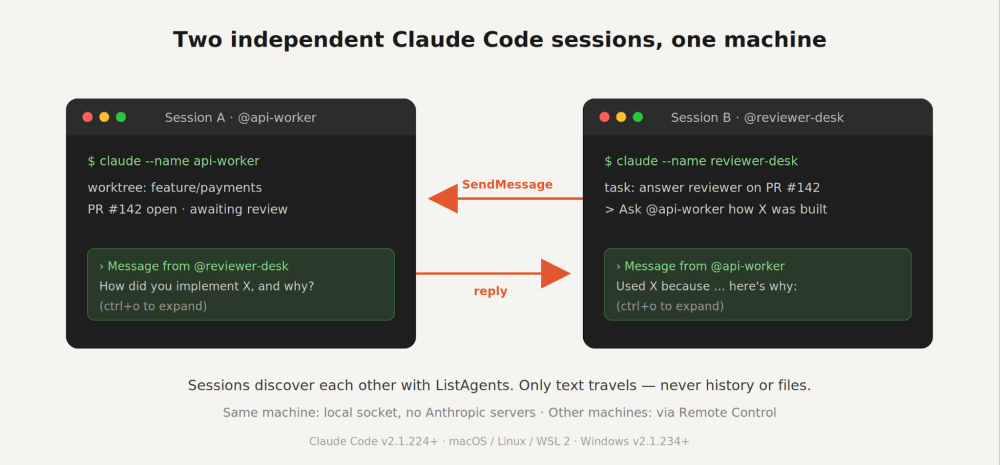
The reviewer asked about an implementation detail. Session A had that context, not me. Instead of switching terminals and digging through the code, I asked it from session B. I got a concrete answer with the reasoning behind it and replied to the reviewer. Zero copying.
These are not subagents
First reaction on the channel: “but the main agent always talked to its subagents.” True, but this is different. Here two independent Claude Code instances are talking — separate processes, separate worktrees, separate contexts. And it’s not limited to one host: through Remote Control, sessions on different machines see each other too.
Worth knowing
- Since v2.1.224 (August 7) on macOS and Linux, including WSL 2. Native Windows from v2.1.234.
- Nothing to enable, it’s there and it works.
- Only text travels, never conversation history or files. Full context moves via /resume.
- Since v2.1.232, an @session-name in your prompt is enough to message a specific session.
- Agents can message each other on their own, without you, if you let them. You control this with the crossSessionInbound setting (accept / hold / refuse). Messages leaving the machine can additionally require your approval, even in bypassPermissions.
Watch out for
- The feature has fresh regressions behind it: after Claude Code auto-updated from 2.1.258 to 2.1.260, users reported SendMessage stopping in open sessions. If something breaks after an update, it’s a known topic.
- A question from the channel worth asking yourself: if agents can talk without a human, could one start poking around in a session it shouldn’t? Answer: they can, if you allow it. That’s why crossSessionInbound: refuse exists.
If you run several agents at once on related tasks, the manual relay has just stopped being necessary, at least for me.
Share this article: