

AI Product MVP Checklist: 12 Decisions to Make Before You Build
A regular software MVP forgives some ambiguity. You can defer an architecture choice, patch a data model later, or bolt on monitoring after launch. An AI MVP is less forgiving. Decisions about data readiness, model choice, and failure handling are structural. They determine what the system can become long after launch, well beyond how fast you ship the first version.
This checklist walks through the 12 decisions worth making deliberately before the first sprint starts. None of them require a finished product strategy. All of them are cheaper to get right now than to unwind after your first users are live.
Table of contents
Why AI MVPs break differently than regular MVPs
A conventional MVP is built to test demand: is there a problem worth solving, and does your proposed solution resonate with it? An AI MVP has to answer that same question while also proving something else - that the AI component behaves predictably enough to trust, at a cost that doesn’t undermine the business case.
That second requirement is where teams get caught out. The model itself usually behaves close to how it did in testing. What changes is exposure: production traffic raises questions your test set never covered, and request volume that looked cheap in a proof of concept starts showing up as a line item finance notices. Neither problem is visible until the system is already live and the assumptions behind it are hard to unwind.The 12 decisions below are grouped into four areas: what you’re building, how the system is architected, how you’ll know it’s working, and who owns it once it ships.
Scope: what problem are you solving
1. Is AI solving the problem, or solving for the pitch
Start by separating the business problem from the AI framing. If a rules-based workflow, a simple classifier, or a well-designed form would solve 80% of the problem, that’s often the right MVP - with AI added at the point where it earns its complexity, not at the point where it sounds impressive in a deck.
2. What does “good enough” look like, in numbers
Before writing a spec, define the accuracy, latency, and cost thresholds that would make this MVP viable - and the thresholds below which you’d kill it. Teams that skip this end up negotiating the definition of success after the results are already disappointing.
3. Who is the first real user, and what do they tolerate
An internal ops team piloting an assistant tolerates a different error rate than an external customer using it to check their account balance. Decide this before you choose an architecture, because the answer changes how much you invest in grounding, guardrails, and human review.
Architecture: how the system is actually built
4. Build, buy, or fine-tune
Most AI product problems don’t need a custom model. They need the right combination of a foundation model, retrieval over your own data, and orchestration logic. Reserve fine-tuning for cases where prompt-based approaches have been tested and clearly fall short - it’s the most expensive option to maintain over time, not the most sophisticated one.
5. What is your actual data readiness - not your aspirational one
Most AI MVPs are gated by data quality, not model quality. If your source documents are inconsistent, undocumented, or scattered across systems with no clear ownership, that’s the real project - the AI layer on top of it is secondary. Audit this honestly before scoping the build.
6. RAG, fine-tuning, or a static prompt: which fits this problem
If the answer needs to reflect a knowledge base that changes weekly, retrieval-augmented generation is almost always the right starting point over fine-tuning. If you’re proving a narrow proof of concept, a well-structured prompt with a small number of examples may be enough for the MVP stage. Don’t reach for the more complex option until the simpler one has demonstrably failed.
7. Which model, and what’s the cost model at scale
Pick a model based on the task, not on which one is newest. Then model your token economics before you build, not after the first invoice arrives - cost per request rarely stays flat as usage grows, and teams that don’t instrument spend by feature are usually the ones facing a bill three times their forecast six months in.
Risk: how you’ll know it’s working, and what happens when it’s not
8. What’s your fallback when the model is wrong
Every AI MVP needs an explicit failure path: what happens when confidence is low, sources contradict each other, or the system simply doesn’t know. A system that fails closed, refusing to answer rather than guessing, is usually safer for an MVP than one optimized purely for response rate.
9. What are your security and compliance non-negotiables
Decide early which data the system can touch, whether outputs need audit logging, and what your data residency requirements are. Retrofitting access control and logging into an AI pipeline after launch is materially harder than designing pre-retrieval authorization from the start.
10. How will you measure success before you’ve launched
Define your evaluation approach - a golden set of test questions, a faithfulness or accuracy metric, a way to catch regressions before the first release, not after users start reporting problems. Without this, every product decision after launch becomes a debate about anecdotes instead of a review of data.
Governance: who owns this after it ships
11. Who owns AI quality once the MVP is live
An AI MVP needs an owner who is accountable for output quality, not just uptime. This is often a different skill set than the engineering team that built the pipeline - model behavior monitoring, prompt maintenance, and evaluation review are ongoing work, not a one-time build task.
12. What are your kill criteria
Decide, in advance, what evidence would tell you to stop, pivot, or scale. Teams that define this upfront make faster, less political decisions three months in. Teams that don’t tend to keep funding an MVP past the point where the data already answered the question.
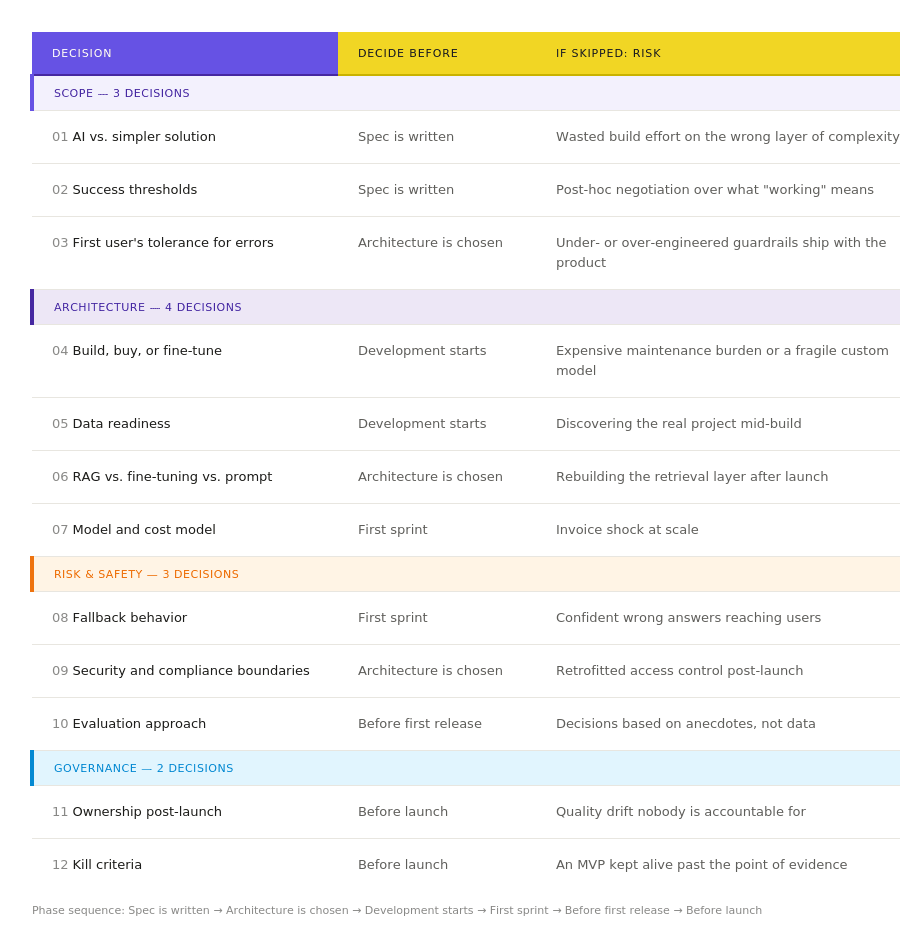
Decision matrix: where each choice gets made
Each row is a decision that compounds if deferred. The “Decide before” column marks the last responsible moment — after that, the default costs you.
FAQ
Do we need a data scientist on the team to build an AI MVP?
Not necessarily. Most AI MVPs today are built on foundation models with retrieval and orchestration, which is closer to backend engineering than to machine learning research. A data scientist matters more once you’re fine-tuning models or building custom evaluation pipelines at scale.
Should the MVP use the most capable model available?
Usually not for every request. Routing simple tasks to smaller models and reserving frontier models for complex reasoning is one of the more reliable ways to keep costs sane as usage grows, without changing the user experience.
How is an AI MVP different from a regular software MVP in terms of timeline?
The build itself isn’t necessarily longer. What takes longer, if you skip it, is the evaluation and guardrail work — teams that treat this as a step to add later usually end up doing it under pressure, post-launch, which is slower and riskier than doing it upfront.
What’s the biggest reason AI MVPs get stuck before launch?
Data readiness. Teams scope the AI layer assuming clean, structured source data, then discover mid-build that the real work is cleaning and organizing that data — not building the model integration.
Is it worth fine-tuning a model for an MVP stage product? Rarely.
Fine-tuning adds ongoing maintenance cost — every base model update potentially requires re-tuning. Most MVP-stage problems are better served by prompt engineering and retrieval, with fine-tuning reserved for narrow, high-volume tasks where the simpler approaches have already been tested and fallen short.
Where this goes next
None of these 12 decisions require a finished product strategy or a committed architecture. They require an honest conversation, early, about trade-offs your team is already going to face - just later, and at a higher cost.
If you’re scoping an AI product and want a second opinion on where your assumptions might be thin, the next useful step is usually a short technical assessment - not a sales call. Boldare’s AI Product Development & Consulting team works through exactly this kind of scoping before a single sprint is planned.
Share this article: